

The final weeks of the year bring a familiar to-do list: review your investments, top off retirement savings, and make any last gifts. But 2026 is the first tax year shaped by the One Big Beautiful Bill Act (OBBBA), and a few of the rules that guide year-end decisions look different than they did a year ago.
To help you stay ahead, we’re sharing our 2026 Year-End Planning Guide. It covers the questions worth asking before December 31, from tax planning and cash flow to insurance and estate planning.
Areas to Review Before Year-End
1. New Rules for Charitable Giving
Under the One Big Beautiful Bill Act, beginning with the 2026 tax year, taxpayers who take the standard deduction may be able to deduct up to $1,000 ($2,000 for married couples filing jointly) in cash gifts to qualifying charities. For those who itemize, charitable contributions are generally deductible only to the extent they exceed 0.5% of adjusted gross income (AGI), and for taxpayers in the top bracket, the tax benefit of itemized deductions is limited to 35%. These provisions are subject to IRS guidance, and their application will depend on your individual tax situation.
These changes may affect how much, when, and how you give. Strategies such as bunching contributions, gifting appreciated securities, or making a Qualified Charitable Distribution (QCD) from an IRA if you’re 70 1⁄2 or older may be worth revisiting with your advisor.
2. Medicare and Benefits Enrollment
Medicare’s annual Open Enrollment Period is underway and ends December 7, 2026, with any changes taking effect January 1, 2027. Plan costs and coverage can shift from year to year, so it’s worth comparing your Medicare Advantage or Part D options rather than letting last year’s plan roll over. If you’re on Medicare, keep in mind that year-end income decisions, such as Roth conversions or realizing gains, can also affect future IRMAA surcharges on your premiums.
Many employers also hold benefits enrollment this time of year. Before re-electing last year’s choices, consider reviewing your health plan, HSA or FSA contributions, and retirement plan deferrals to make sure they still fit your goals.
3. Harvesting Investment Losses
Year-end remains an important time to review your taxable accounts. Realizing losses can help offset capital gains, and up to $3,000 of net losses may be used to reduce ordinary income, with any remainder carried forward to future years.
Timing matters. Under the wash sale rule, buying the same or a substantially identical investment within 30 days before or after the sale can disallow the loss, and that window doesn’t reset on January 1. Coordinating these decisions with your overall portfolio strategy can help you capture the tax benefit without drifting from your long-term plan.
Tax-loss harvesting may not be suitable for all investors, outcomes depend on individual circumstances, and this information is not tax or legal advice.
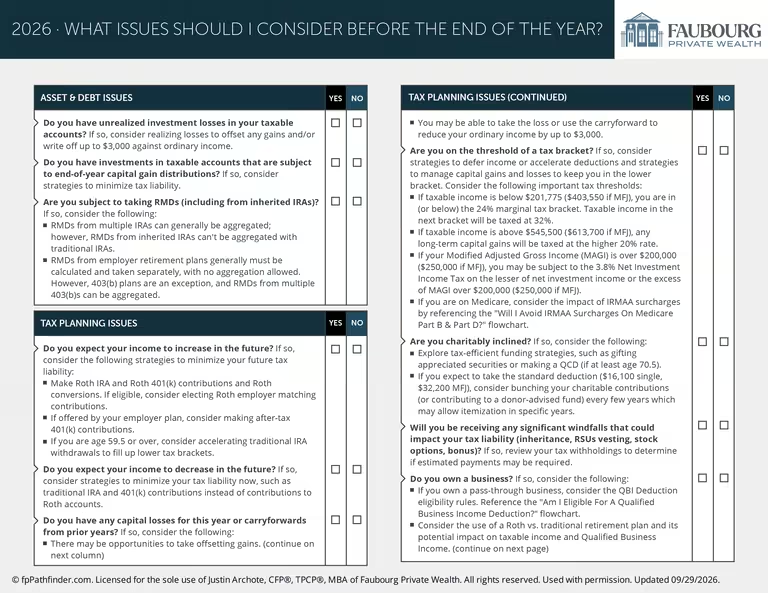
What Issues Should I Consider Before the End of the Year?
The news above is only part of the picture. Our two-page checklist walks you through the key questions to ask before the year ends, in a simple yes-or-no format. Each “yes” points to a planning opportunity worth exploring.
Inside, you’ll find questions across six areas:
- Asset & Debt: unrealized losses, capital gain distributions, and required minimum distributions (RMDs)
- Tax Planning: tax bracket thresholds, Roth strategies, charitable giving, windfalls, and business owner considerations
- Cash Flow: HSA, 401(k), and 529 contributions
- Insurance Planning: FSA balances and health insurance deductibles
- Estate Planning: family changes and annual gifting
- Other Issues: college planning and upcoming law changes
The checklist also includes key 2026 figures, such as the $24,500 maximum 401(k) salary deferral and the $19,000 annual gift tax exclusion, so you have the numbers in one place.
Finish the Year With a Plan
Already a client of Faubourg Private Wealth? Let’s connect before the holidays. Schedule your year-end review, and we’ll walk through the guide together and focus on the moves that make sense for you before December 31.
Not working with an advisor, or considering a change from your current one? We’d welcome a conversation about where you are today and where you want to go.
Contact us online today or give us a call at (504) 321-0923 to see if we may be a fit for you.
Advisory services are offered through Faubourg Private Wealth, a dba of Second Line Capital LLC, a registered investment advisor. Registration does not imply a certain level of skill or training. More information about the advisor, its investment strategies, and objectives is included in the firm’s Form ADV Part 2, which can be obtained, at no charge, by calling (504) 321.0923 or (985) 612.7600.